
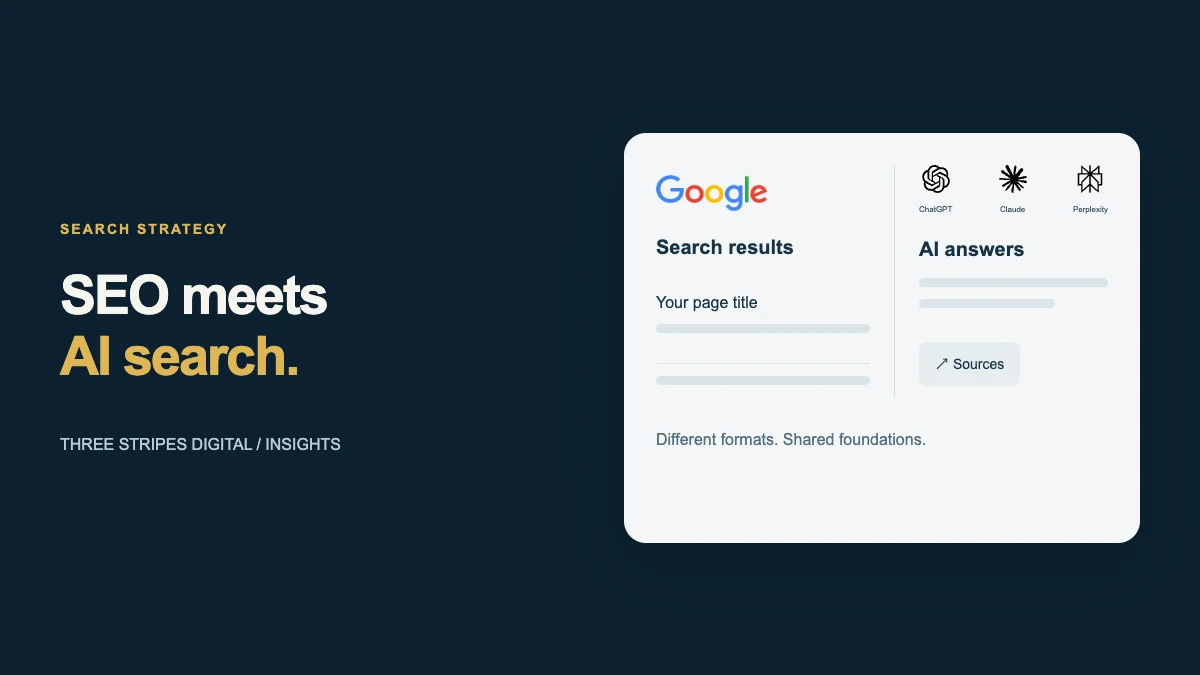
GEO and SEO serve related discovery paths
A search result often leads a visitor to a page. A generated answer may summarize information from several sources before that visitor decides to click. Your business therefore needs pages that work for people arriving directly and information that remains clear when referenced elsewhere.
The two overlap heavily. A page that answers the search well is usually the page an assistant can quote, and the same crawl access, accuracy and clarity serve both. Where they part company is in what you measure and in how self-contained each sentence has to be.
Compare the goals and the evidence
Three terms get used for closely related work. SEO is being found among search results. AEO — answer engine optimization — is the narrow job of making one question answerable straight from your page, in a sentence or two, wherever that answer is displayed.
GEO — generative engine optimization — is the broader job of being a source a generated answer draws on and names. AEO is about the sentence; GEO is about the page and the business behind it.
| SEO | AEO | GEO | |
|---|---|---|---|
| Discovery | Relevant search results | A direct answer shown above or instead of the links | Relevant generated answers and recommendations |
| Useful signals | Queries, landing pages and visits | Which of your sentences is the one displayed | Mentions, citations and identifiable referrals |
| Content job | Satisfy the visitor’s search intent | Answer one question completely and early on the page | Provide clear, credible information worth referencing |
| Business goal | Qualified cases, appointments or purchases | The same outcomes, sometimes without a click | The same business outcomes, through another discovery path |
A position report, an answer-appearance report and a citation report answer different questions. None of them replaces conversion measurement. Agree on the customers you want and the actions that matter before judging a channel by its easiest metric.
Keep one strong content foundation
Google explains that established SEO practices remain relevant to its generative search features in its AI optimization guidance. Treat that as a reason to build a useful foundation, rather than chase a second set of pages with no distinct purpose.
Map each important need to a useful destination: a service page, a product or collection, a location page, a research resource or an explanation. Add original expertise and support claims with evidence, and keep the links between those pages deliberate so a visitor can continue their research.
State the business facts once, and mark them up with the standard schema.org Organization vocabulary, so a machine reads the same name, address and service description a person does.
One page, two sets of requirements
| The page element | What search needs from it | What a generated answer needs from it |
|---|---|---|
| The opening paragraph | A match for the query the visitor typed | A self-contained sentence that survives being lifted out of the page |
| Pricing and scope | Enough detail that the visitor does not bounce back to compare | A specific figure or range an assistant can attribute to you |
| Proof | Case studies a visitor can click into | A named client, market and date that can be repeated accurately |
| Business identity | Consistent name, address and service area for local results | The same details wherever an assistant may have read about you |
| Crawl access | Googlebot can reach and render the page | The assistant’s own crawler is allowed as well |
The requirements overlap more than they conflict. Where they differ, the difference is usually specificity: search rewards a page that answers, and an answer engine rewards a sentence that can be quoted.
For ChatGPT search, review OpenAI’s documentation for OAI-SearchBot and its other crawlers. For other platforms, examine the actual answers and cited sources relevant to your market. Do not assume that the same prompt always produces the same recommendation, or that one platform’s behavior explains every other platform. Our guide to ChatGPT SEO works through the audit itself.
Choose priorities from the customer journey
If core pages cannot be found or do not explain the offer, fix those first. If relevant visitors arrive but do not take the next step, investigate the page and conversion path. If important buying questions are absent from your content, fill that gap with useful expertise.
A connected plan can include SEO, AI visibility and conversion-focused web design. The right mix comes from your market and the evidence, not the popularity of an acronym.
A FEW THINGS YOU MAY BE WONDERING
Good questions. Clear answers.
Is AEO different from GEO?
Slightly. AEO is about being the answer to a direct question; GEO is about being a source a generative system draws on. In practice the same clear, well-supported pages serve both.
Does GEO replace SEO?
No. Generative answers are built from indexed content, so a page that cannot be crawled cannot be cited. GEO adds a layer of measurement and clarity on top of search fundamentals.
Do AI answers require special schema?
No. Structured data helps a machine read a page accurately, but no AI-specific markup earns inclusion. Standard, correct schema alongside genuinely useful content is the whole of it.
Which should a small business invest in first?
The shared foundation, because it pays into both: crawlable pages, accurate facts, clear answers. Add prompt tracking once that exists and you have something worth monitoring month to month.